The "W40" Exposure Guide
Forget Sunny 16. Embrace the Gloom: The “W40” Exposure Guide
By a Northern photographer, for Northern photographers.
Let’s be honest for a moment. I am tired.
I’m tired of opening photography manuals or watching YouTube channels where smiling film photographers in California explain how life works. You know the type. They live in a world where light is an infinite resource. Their biggest creative struggle is deciding whether to shoot a surfer on a golden beach at 10 AM or a model in a bikini at 4 PM.
For them, the “Sunny 16” rule is a law of nature. “Set aperture to f/16, shutter to 1/ISO. Magic!”
Sure, it’s magic in Los Angeles. But for us? For those of us in Northern France, the UK, or anywhere where summer falls on a random Tuesday afternoon?
We have history. We have cobblestone villages, slate steeples, and pastures so green they look fake. But mostly, we have The Ceiling. That low, uniformly white, headache-inducing sky. That constant drizzle that doesn’t quite wet you but soaks into your soul.
For us, “Sunny 16” is annoying. It forces us to do constant mental gymnastics, starting from f/16 (an aperture my lens hasn’t seen since 1998) and calculating down. “It’s grey, so f/8? No, dark grey, so f/5.6?” It’s exhausting.
That is why I developed a method adapted to our meteorological despair. A method that embraces our reality.
Forget Sunny 16. Meet the W40.

The W40 Concept: Grey is the new Gold
The name is simple: W for “White Sky” (our daily bread) and 40 for ISO 400.
Why ISO 400? Because let’s be serious. Loading ISO 100 film in the North is optimism bordering on delusion. ISO 400 is the sensitivity of survival.
The philosophy of W40 is to shift the reference point. Instead of assuming the “zero” is bright sun (f/16), we decide that the standard situation—our “zero”—is a Bright Overcast Sky.
The New Golden Rule
In this standard configuration (ISO 400, overcast but bright), the perfect exposure isn’t f/16. It is f/5.6.
Why f/5.6? It is the “sweet spot” for most lenses, it offers decent depth of field for street or landscape, and crucially, it lets in enough light.
At ISO 400 and f/5.6, what is the corresponding shutter speed for a grey sky? It is 1/500th of a second.
This is your new mantra: “When it’s white, I’m at 500 and 5.6”.
The “Speed Ceiling” Problem
Many of us shoot with vintage mechanical cameras (Rolleicords, old Leicas, Spotmatics). These engineering marvels often have a hard limit: a maximum shutter speed of 1/500s.
This creates a conflict. If our base setting for a grey sky is already at the maximum speed (1/500s at f/5.6), what do we do if, by some miracle, the sun comes out? We can’t increase the speed to compensate.
The W40 system solves this by splitting the world into two distinct zones.
1. The Cloud Zone (95% of the time): Shutter Priority
This is our comfort zone. As long as there are no cast shadows on the ground, you are here.
The rule is simple: Your Aperture is LOCKED at f/5.6. You don’t touch it.
You manage exposure solely with the shutter speed dial, slowing it down as the depression sets in.
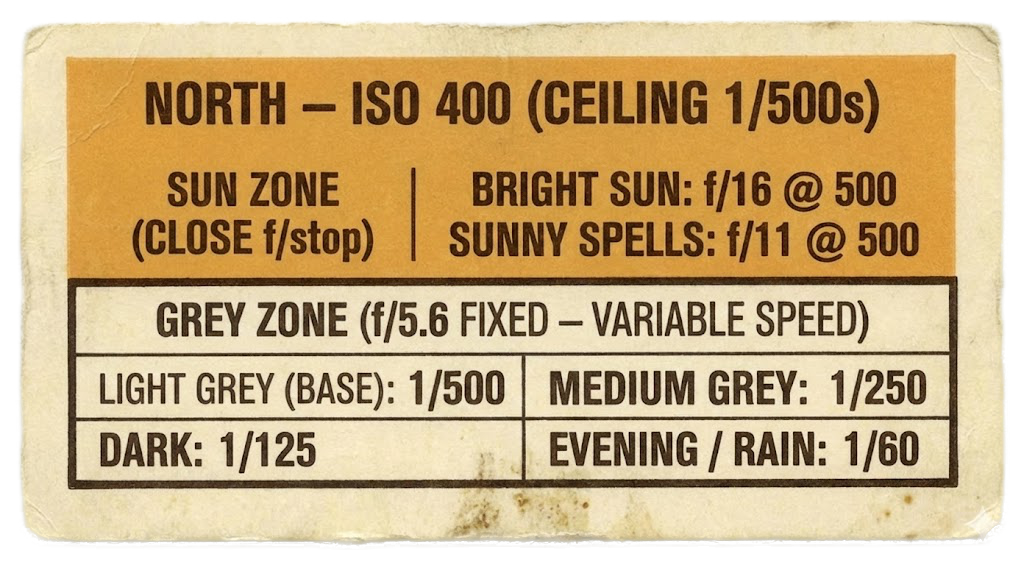
- Bright White Sky (Base): 1/500s
- Mid-Grey Sky: 1/250s
- Dark Grey (Threatening): 1/125s
- Evening / Rain: 1/60s (Lean against a wet wall to steady yourself).
2. The Sun Zone (The Emergency): Aperture Priority
This is the worst-case scenario: nice weather. You see your own shadow on the pavement. Your meter panics. You are already at 1/500s (your max) and f/5.6. You are about to overexpose massively.
Since you cannot change the speed, you must close the light valve: the aperture.
The rule changes: Your Speed is LOCKED at 1/500s.
- Sunny Spells (Soft shadows): Close to f/11.
- Bright Sun (Rare, but possible in July): Close to f/16.
The W40 Chart (Print and Stick)
To save you from thinking in the rain, here is the summary table. It is organized in a “cascade,” from brightest to darkest.
Read it from top to bottom. Stop at the first line that matches your sky.
Conclusion
W40 isn’t just an exposure chart. It’s a pragmatic approach to our environment. It accepts that our light is soft, diffuse, and sometimes difficult.
With this method, you stop cursing the lack of sun. You walk out with your camera pre-set to f/5.6 and 1/500s, ready to capture the subtle beauty of a trailing sky over red brick architecture. And if the sun dares to show up? You know what to do: stop down, and wait for it to leave.
Happy shooting, and don’t forget your umbrella.